
Plymouth Township City Directory Years
Historical directories for the Plymouth and Northville area are a fragmented run, not an unbroken annual set. Established genealogy and digitized collection listings identify local volumes for 1938, 1941, 1943, 1946, 1948, 1951, 1953, 1956, 1957, 1958, and 1960. A local newspaper report also documents delivery of a special 1976 Plymouth/Northville issue. The first local year, the full 1961 through 1975 run, and the last printed year were not located. Keep the year and publisher with every transcription, especially because the independent City of Plymouth and Plymouth Township share a postal identity but are separate jurisdictions.
| Collection | Years | Where held | Access |
|---|---|---|---|
| Plymouth/Northville directories | 1938, 1941, 1943, 1946, 1948, 1951, 1953, 1956-58, 1960 | Cataloged local-directory repositories and digitized collections | Repository and account access vary |
| Special bicentennial directory | 1976 reported | Local Observer archive report | Use as a dated special issue, not proof of a continuous run |
| Polk directory holdings | Late nineteenth-century Michigan holdings; exact early Plymouth run not found | Library of Michigan | Print, microfilm, fiche, or partner databases |
| Bresser and criss-cross material | Mostly late 1960s in state holdings; exact local run not found | Library of Michigan and partners | Check the catalog and the volume itself |
Dates are evidence, not decoration. A listing can place a household in a printed volume, but it does not prove the person lived at that address before or after the publisher’s survey.
Plymouth Township Directory Shelves
Plymouth District Library’s research resources connect local-history users with the Plymouth Observer and Community Crier archives, genealogy databases, and access routes for Ancestry Library Edition, HeritageQuest, FamilySearch, MeL, and interlibrary loan. Ancestry Library Edition is available in the library, while HeritageQuest is available to eligible users remotely. The library does not publish a complete numeric directory shelf list, so the reference desk is the practical place to ask whether a printed, microfilm, or licensed copy exists for one target year.
The library lists hours of Monday through Thursday from 10 to 9 and Friday through Sunday from 10 to 5. Its local newspaper links are useful when a directory supplies a name and street but no explanation for a move, death, marriage, civic notice, or business reference.
The library research page is shown below with its local-history and database pathways.

Use the database route that matches the year, and preserve the publication title and page citation when copying an entry.
Plymouth Township Directory Reading Rooms
The Library of Michigan directory guide explains where its print volumes, microfilm, and fiche are kept: directories are arranged on 2nd Floor South by city or county, with microfilm and fiche in the 2nd Floor South Microfilm Room. Search the ANSWER catalog using the city name and its directory subject terms. The guide also identifies Polk, Bresser, Robinson’s, Norton’s, Johnson Publishing, W.C. Bailey, and Luedder among publishers encountered in Michigan collections.
That publisher information matters because layout changes. A Polk volume can place a name in one part and an address in a street section, while a later Bresser volume may begin with the street. Read the title page and abbreviation key before comparing two entries.
The state directory guide illustrates the collection and search approaches.
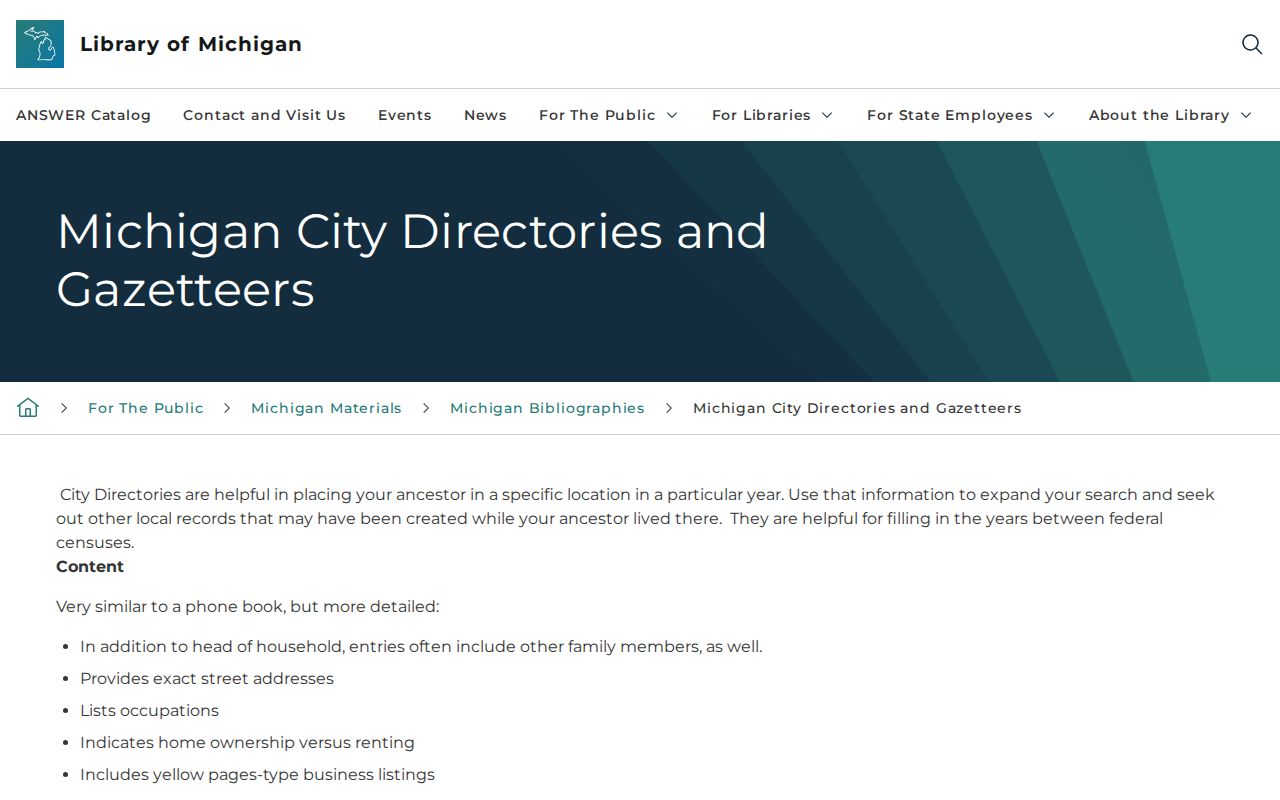
Its shelf and microfilm guidance provides a fallback when a local digital search does not return the desired year.
Reading a Plymouth Township Directory
A Plymouth Township directory entry must be read in the format of its own volume. The Library of Michigan describes Polk name listings as surname-based entries that may show occupation, other household members, and ownership information. A street section is alphabetical by street and then house number, and can show residents or businesses at the address. Phone and classified sections may supply a head of household or a cross-reference. Do not assume every column appears in every year.
| Name as printed | Record surname-first spelling, initials, and any spelling variant. |
|---|---|
| Occupation or business | Note the wording exactly; it can distinguish people with the same name. |
| Household notation | Copy spouse, widow, relocation, or other notation only when that volume displays it. |
| Street address | Keep the house number and street form as printed, then compare it with the street section. |
| Phone or ownership mark | Record the phone section reference or owner/renter mark with the publisher’s key. |
One entry should be treated as a research note, not a quotation from an unseen page. A text-accessible image of a local printed entry and its exact key were not available in the source review, so symbols should be verified against the volume being used.
- Criss-cross directory
- A reverse arrangement that starts with a street and number, then identifies the head of household, phone, and sometimes owner or renter notation.
- Householder index
- A name-focused arrangement that may list the person chosen by the publisher as the household head rather than every resident.
- Abbreviation key
- The publisher’s explanation of marks such as widow, new arrival, relocation, or ownership, usually found in the front matter.
Plymouth Township Digitized Directories
U.S. City Directories, 1822-1995 is a digitized collection that includes the identified Plymouth years, though access can require an account or library route. Other repositories in the local-year inventory hold parts of the run. Search a surname with a year first, then try the street and address spelling from the entry. A failed result can reflect an index transcription, not an absent page.
When an address is the starting point, look for a Bresser or criss-cross section before assuming a name index will reveal the household. The historical collection detail belongs with the directory volumes; modern parcel evidence is handled through the Plymouth Township street directory.
The digitized directory collection provides one online access path for the identified local years.
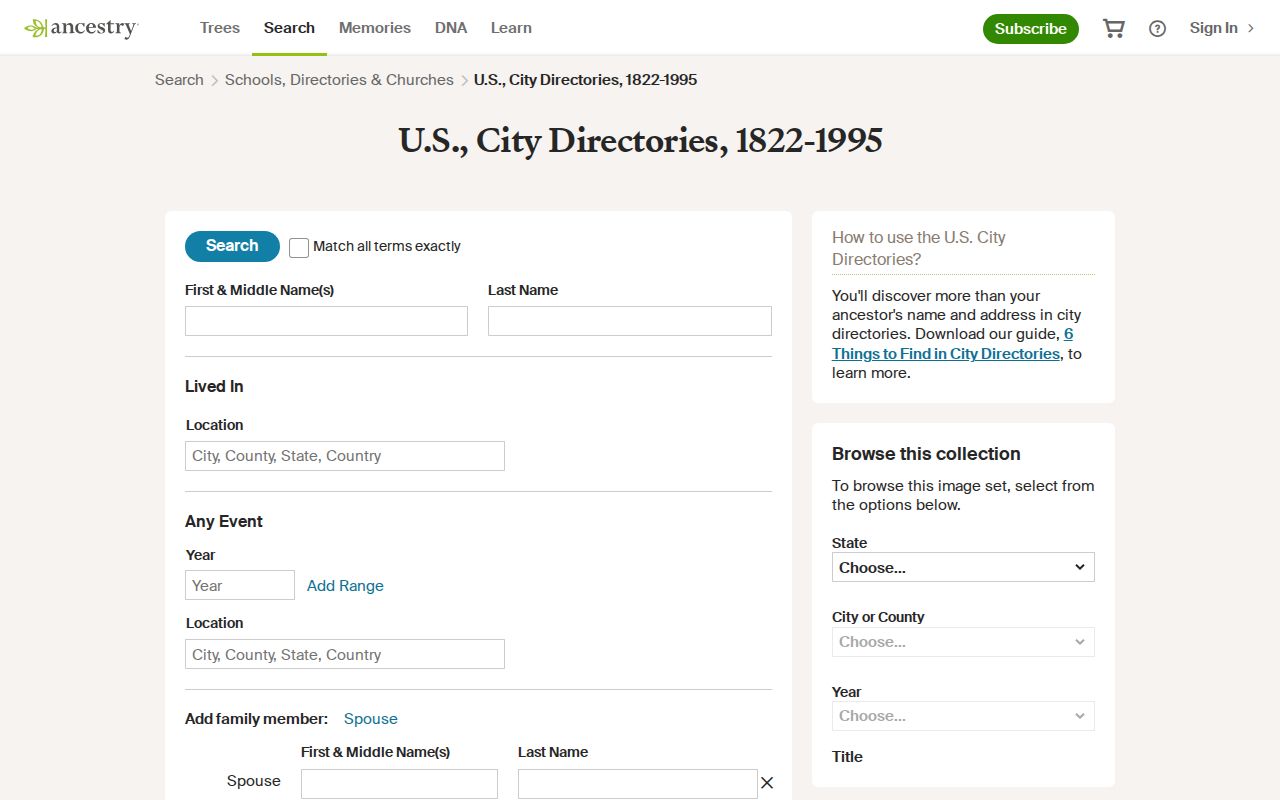
Library access can be the better route when a commercial account does not expose a particular page image or search result.
Note: A web result without the title page or year should be checked against the bound or digitized volume before it is added to a family timeline.
Plymouth Township Directory Timeline
Local directory evidence has useful anchors but real gaps. The safest timeline records only years verified in the collection inventory and separates broad statewide holdings from proven Plymouth Township content. That prevents a convenient shelf label from becoming an unsupported claim of annual coverage.
- 1938: first verified local Plymouth/Northville volume in the established directory list.
- 1941-1953: separate verified volumes appear for 1941, 1943, 1946, 1948, 1951, and 1953.
- 1956-1960: verified local volumes include 1956, 1957, 1958, and 1960.
- 1976: a local Observer report says R.L. Polk & Co. Taylor delivered a special bicentennial Plymouth/Northville directory.
The intervals between those dates are unverified. Treat them as gaps that need a catalog search, not as evidence that a household disappeared.
Tracing Plymouth Township Directory Households
Family history becomes stronger when each entry is paired with an independent dated source. Use the address and spelling from one directory year to search the next listed year, then compare the household against the decennial census nearest to that point. Federal census schedules through 1950 are public under the 72-year rule. National Archives census access is useful for the federal schedule, while local holdings add a Plymouth-focused way to organize the search.
- Start with the earliest verified name or street listing and transcribe its year, publisher, page, address, and every abbreviation.
- Check the next available local directory, rather than assuming a missing publication year contains the same household.
- Use a street or criss-cross section, when present, to test whether the address carried a different household head.
- Pair the closest entry with the relevant federal census and compare names, ages, relationships, and residence.
- Use a newspaper notice, cemetery finding aid, or probate material to investigate a move, death, or transfer after the last entry.
A disappearance can mean a move, death, a different spelling, a publisher’s choice, or a gap in the available run. It should not be treated as a conclusion until another local source supports it.
Plymouth Township Directory Census Bridge
Plymouth Historical Museum Archives supplies a local bridge for directory work. Its holdings include Wayne County census material excluding Detroit for 1850 through 1930, a 1890 Special Census, Plymouth mortality schedules, family genealogy from 1840 forward, the Plymouth Mail from September 1887 through December 1954, and Wayne County atlases from 1876 and 1893. Weekday access is available when an archivist is present, weekends are by appointment, and archivist research carries a minimum $25 donation.
The 1890 Special Census is especially valuable because the ordinary federal 1890 population schedule is generally missing. Confirm the geographic scope and exact pages with the Museum before treating it as a household match.
The Museum archive service is shown below with the local collection that can connect a directory entry to newspaper, census, or atlas evidence.
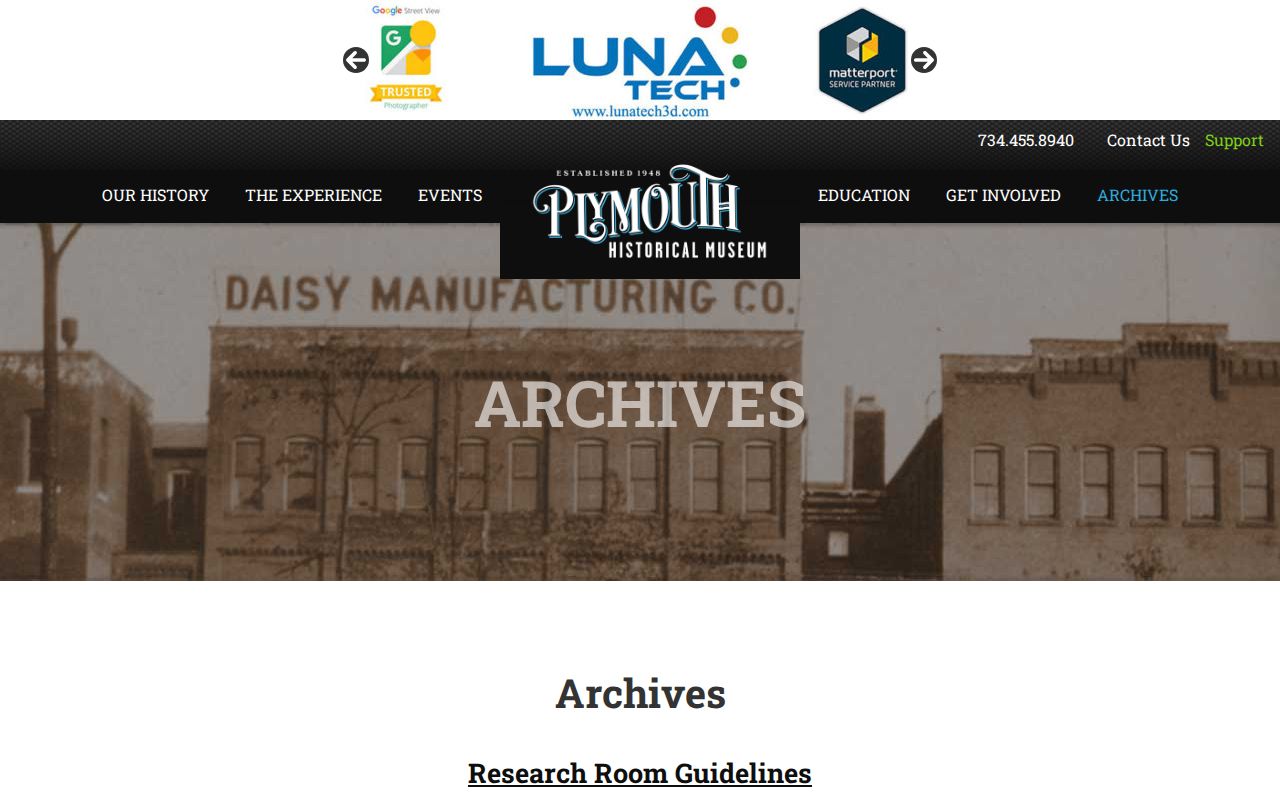
For rural-era households, the atlases and family files can explain why a name is tied to a farm, road, or section rather than a modern street number.
Plymouth Township Record Clues
Early Plymouth Township records may describe people by farm, road, section, or nearby landholder. The township was established in 1827, and the 1876 atlas reflects a rural landscape that predates today’s suburban address pattern. Keep an old location description alongside the surname, then compare it with later plats, deed legal descriptions, and neighboring names instead of forcing it into a modern street number.
Burial research has a local caution as well. Shearer Cemetery dates to 1826, and some remains were removed to Riverside in 1956. A family search may therefore need the Museum cemetery finding aid and both cemetery names. The evidence can close a historical trail, but it does not create a complete resident roster.
Note: Retain the municipality field with every record because a Plymouth mailing address and ZIP 48170 can refer to the city or the charter township.